Lessons in Leadership from the Ascent of Everest (with acknowledgement to Gijs van Wulfen)
“It is not the Mountain we conquer but ourselves”
Sir Edmund Hillary KG ONZ KBE (1919 – 2008)
Some background to the first summit of Everest
Nepal allowed one expedition per year. After a reconnaissance expedition in 1952, the British were planning an Everest attempt in 1953 which would consist of a huge team of over 400 people, including 362 porters, 20 Sherpa guides and almost 5,000 kilograms of baggage.
A lot of things go into putting one climber on top of Everest
It’s 8,848m high! The physical conditions are extreme – altitude, weather (cold, wind), treacherous terrain (icefall, crevasses, avalanche). It needs a diverse group of core and support team elements (i.e. people, culture, personal versus team objectives and perspectives). It’s an extreme logistical challenge to establish base and other camps and to keep higher camps adequately stocked. There is a limited window of time (seasonal and weather limitations). And there’s pressure to succeed!
An expedition needs…
Technology – leading edge vs proven e.g. oxygen equipment, tents, clothing
Climbing skills (technical proficiency)
Mountaineering experience
A good track record
Psychological balance (emotional intelligence)
“The successful climber does not fight his / her environment. S/he must become attuned to it, interpreting the signs and taking appropriate actions. S/he needs to adapt their strategies to the changing realities of the elements, the terrain and capabilities of the other team members.”
We’re going to look at some aspects of leadership as demonstrated by this massive feat.
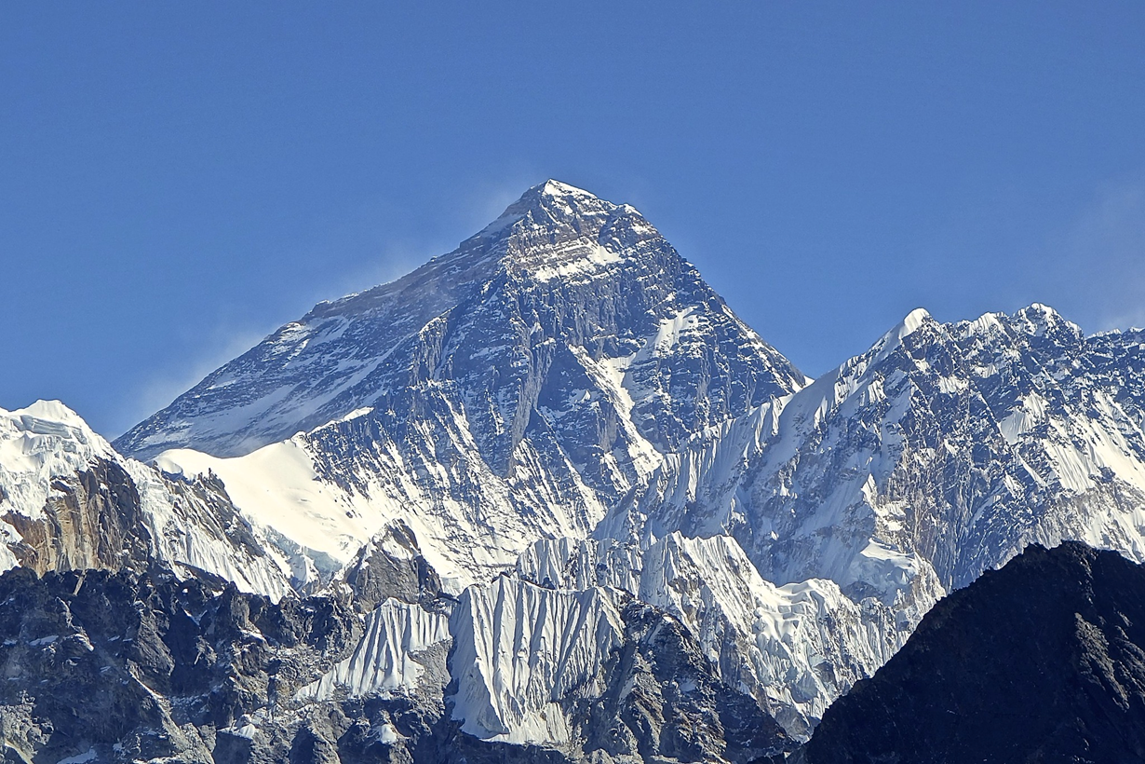
Mount Everest taken at an elevation of 5,300 meter from Gokyo Ri, Khumbu, Nepal credited as having been taken by Wikipedia user ’Rdevany' on 5th November 2012.
Creating a sense of urgency
The British had already made 8 attempts on Everest!
1921 Reconnaissance: Primarily a mapping and route-finding expedition.
1922 Climbing Attempt: The first formal attempt to reach the summit, reaching 8,300+ meters.
1924 Climbing Attempt: Famous for the disappearance of George Mallory and Andrew Irvine.
1933 Climbing Attempt: Reached roughly the same altitude as the 1924 expedition.
1935 Reconnaissance: A smaller, lower-budget scouting expedition.
1936 Climbing Attempt: Thwarted early by an unexpectedly early and severe monsoon season.
1938 Climbing Attempt: The final pre-WWII attempt, testing lighter equipment.
1951 Reconnaissance: The first British look at the southern route through Nepal after Tibet closed its borders
After 8 attempts, they couldn’t fail again!
In 1952, they heard that the French had been given permission to attempt Everest in 1954.
When you’re leading change or wanting to undertake an enormous task, the first step is to create a feeling of urgency, so people say, ‘This is important, let’s get on with it’! You can help others see the need for urgency using facts and data and emphasise the importance of acting immediately.
So 8 attempts and the French snapping at their heels created the urgency to succeed.

1. Urgency
Ed Hillary had been part of the 1951 reconnaissance expedition to the mountain. When he read that they were taking an expedition to the south side of Everest in 1953, he wrote to the expedition leaders suggesting that a New Zealand contingent could make a useful contribution.
Sometimes you need to act quickly. Having Initiative means taking Action. You need to see the opportunities, act on what you know (not always with full information) and take well-calculated risks.
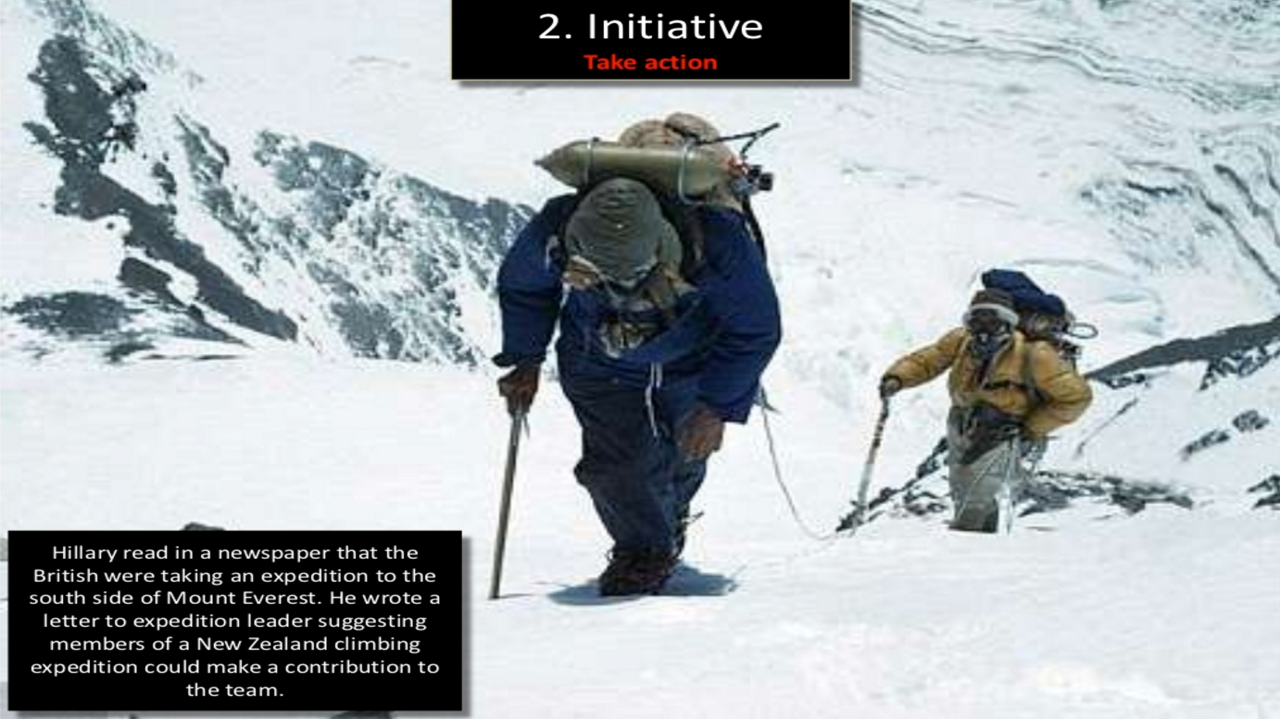
2. Initiative
As a New Zealander, Hilary was lucky in that he was classified as a British subject and therefore eligible to join the expedition team.
What is Luck? It’s defined as “success or failure apparently brought by chance rather than through one's own actions.” Arnold Palmer said "The more I practice, the luckier I get.“ Some people say –You make your own luck! Or to put it another way, luck is preparation meeting opportunity!
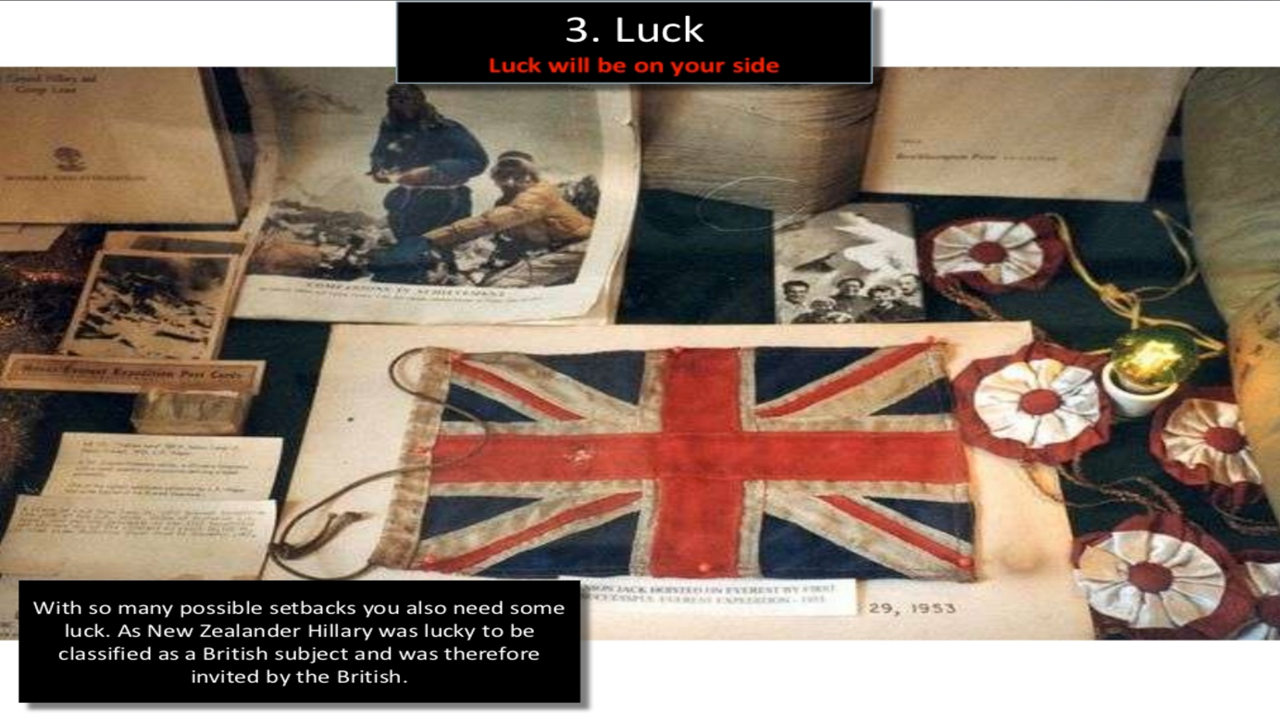
3. Luck
Hilary had been passionate about mountain climbing since he was young. He had climbed many New Zealand peaks and was highly regarded as a climber.
We are always told to follow our passion! It’s what turns a job into a vocation. If you love what you do, it’s not work anymore! If enthusiasm and passion are present, people tend to be more resilient when encountering obstacles. People who are passionate about what they do, rather than just "in it for the money," tend to be people who have more positive outlooks and can overcome difficulties through problem-solving.
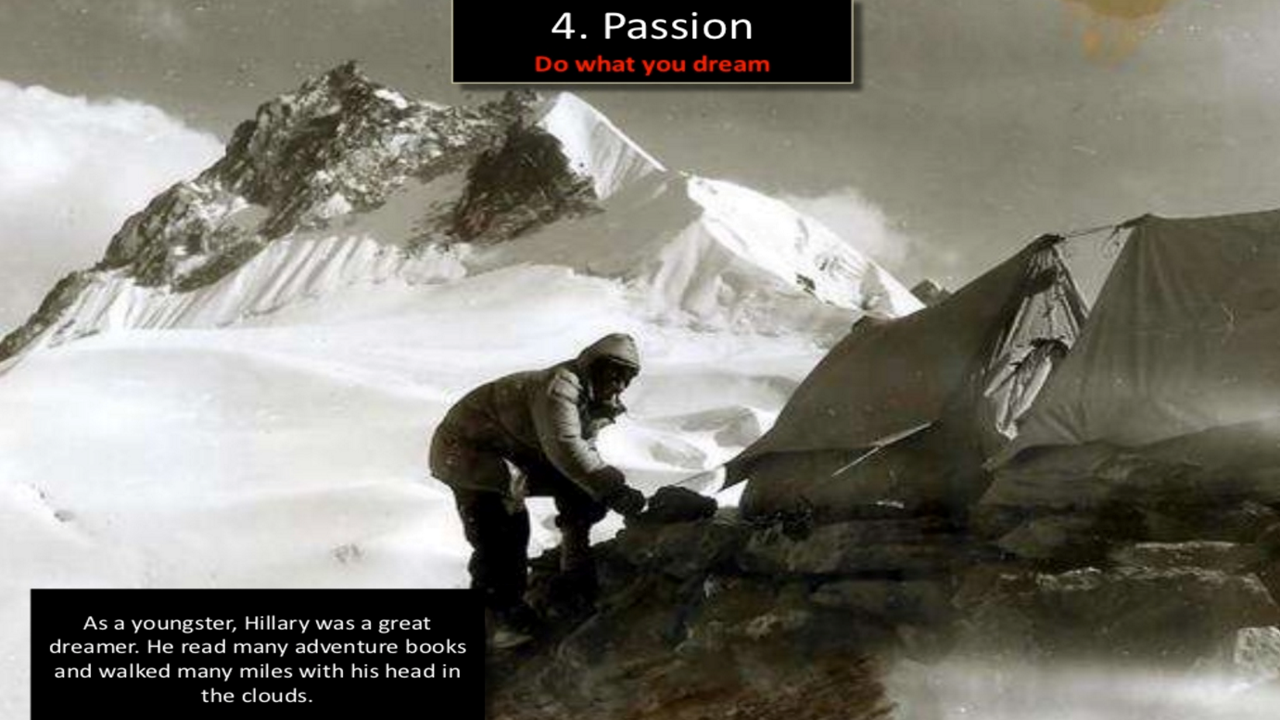
4. Passion
ter 8 failed attempts to climb Everest, the British Himalayan committee needed someone who would get them to the top in 1953. They replaced team leader Eric Shipton with Colonel John Hiunt.
It’s all about Choices. You need to reconcile resources and objectives. Pay attention to details en route and do not (always) reinvent the wheel. Take cognisance of lessons learnt.
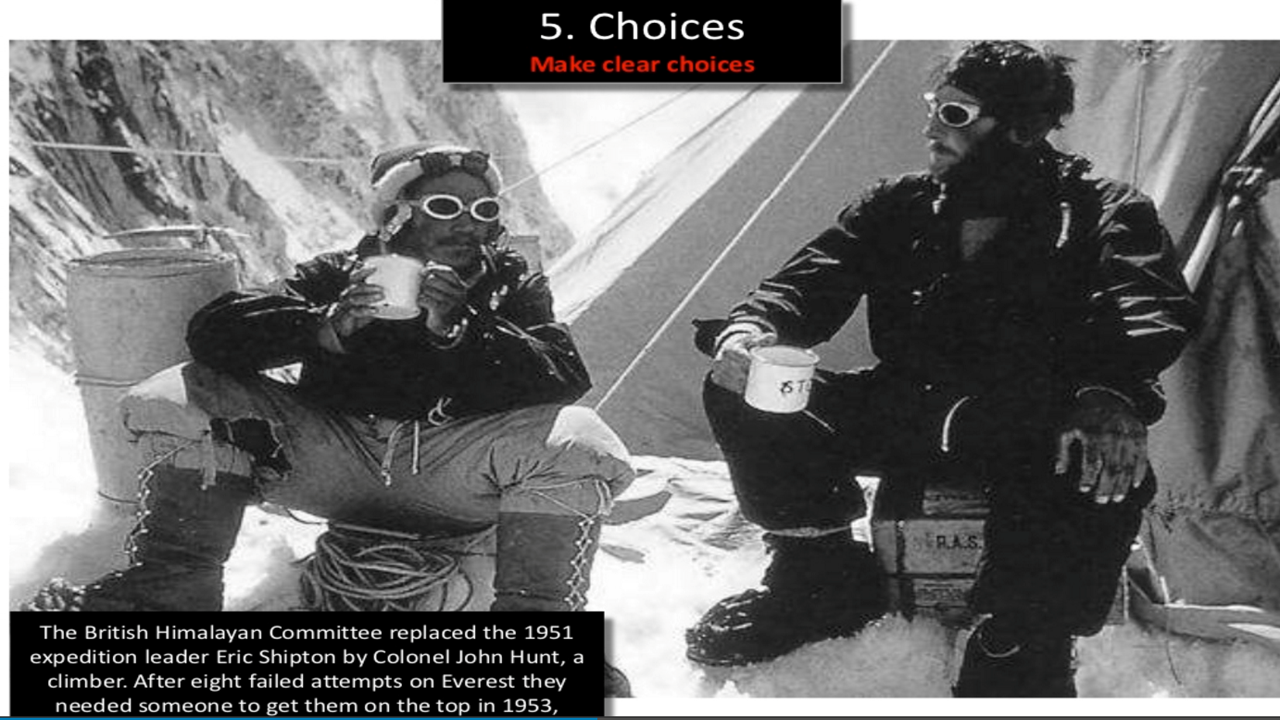
5. Choices
There were many setbacks along the way. In 1951, the British had found what they thought was a new route up the mountain, so they planned the 1953 attempt. Then they heard that a Swiss team had been granted permission for two attempts in 1952. There was nothing they could do but wait and see whether the Swiss would succeed.
As a leader, you will often come up against obstacles, and you have to manage your own emotional roller-coaster. You need to have perseverance and dedication, always holding on to hope and inspiration. So aim for the seemingly impossible, be determined – “press on regardless” and have confidence. Demonstrate trust in people although sometimes you have to be selfish. Exploit your strengths, do what works for you and not for someone else .
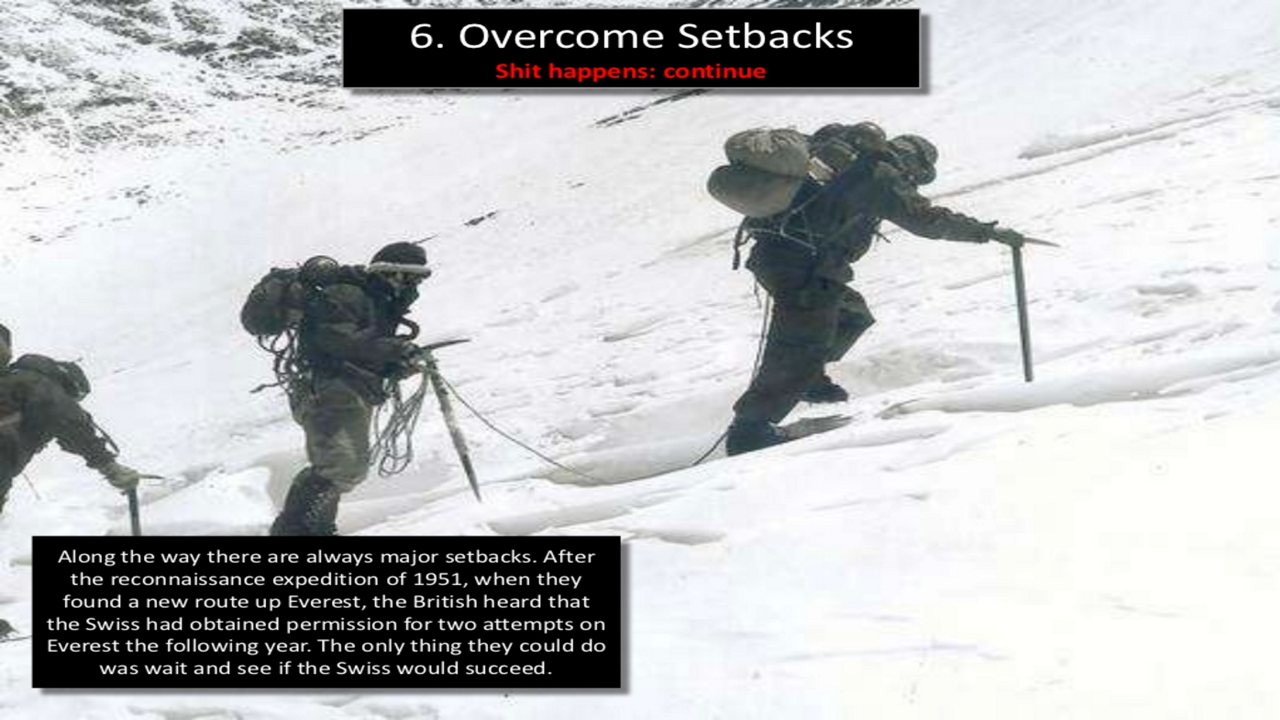
6. Overcome Setbacks
The 1951 expedition had involved testing different types of oxygen equipment and research into high altitude physiology. The results of that research were vital in planning the 1953 expedition.
Testing is a crucial part of leadership skills – it’s never all or nothing so run pilots, test ideas. Discard what doesn’t work and implement what does.
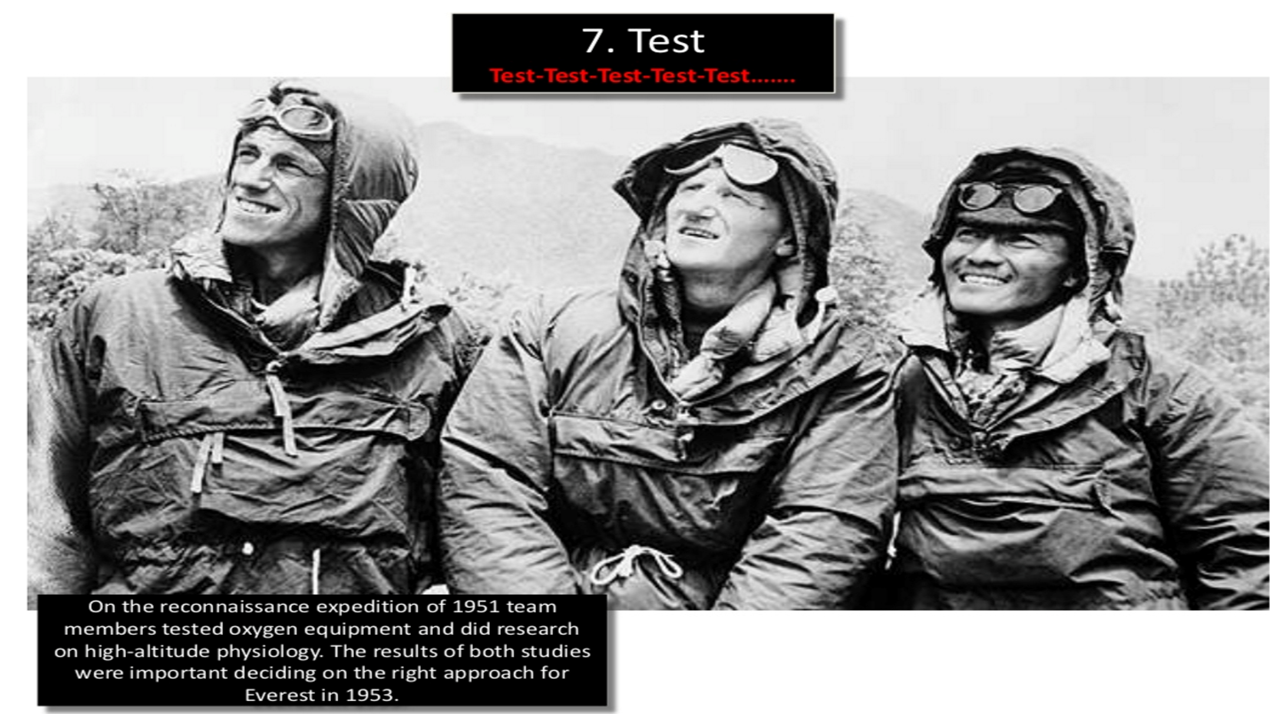
7. Test
Manage the team
The 1953 expedition involved a large team. Hilary wrote that John Hunt and Sherpa Namgyal’s lift to the depot on the Southeast ridge, Alf Gregory and Ang Niyema’s superb support at Camp IX and the pioneering efforts of Charles Evans and Tom Bourdillon to the South Summit all contributed to allowing the team to succeed.
Teamwork is absolutely key. Match people within a team structure, making sure your team includes a variety of types of people. You’re going to need to manage conflict, reward & recognise achievements and celebrate success.
There is no single “hero” in team – it is all about how well the team integrates as a single unit. You have to manage the emotional roller-coaster and ensure people are left with a sense of fulfillment and achievement.
Make sure you clarify roles & reconcile expectations noting the potential conflict between personal goals vs the main mission (team / expedition goals). Always Communicate! Get to know your team members very well. That will allow you to get buy-in - get people to willingly, enthusiastically go along.
“This might sound very mercenary, but then it must be remembered that in helping the expedition in return for payment, the Sherpas are no different from any other employees on a daily wage, though – in common with an ordinary factory-worker in Britain – they need more than just money to command their enthusiasm as well as obedience. They need to feel that the job is worth doing; they need to develop friendships with their employers and to feel that their efforts are fully recognised. In this respect our two Sherpa leaders were especially important, for I was employing them as managers in the very fullest sense of the word. I consulted the Sherpa Leader at each step, occasionally irritating my lead climbers by accepting Sherpa Leader’s advice on what he felt the Sherpas could do, or even on route selection, in preference to their own. He was left entirely to his own judgment on the choice of individual Sherpas for different roles. ” Expedition Leader John Hunt.
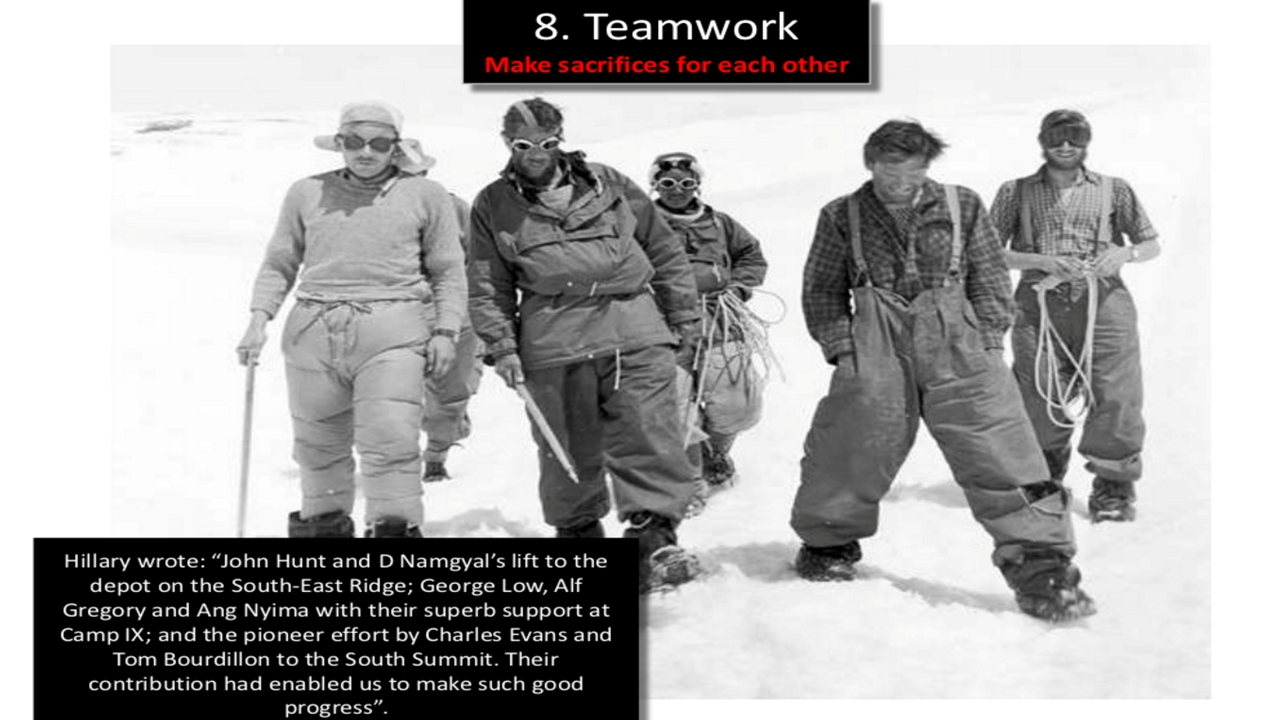
8. Teamwork
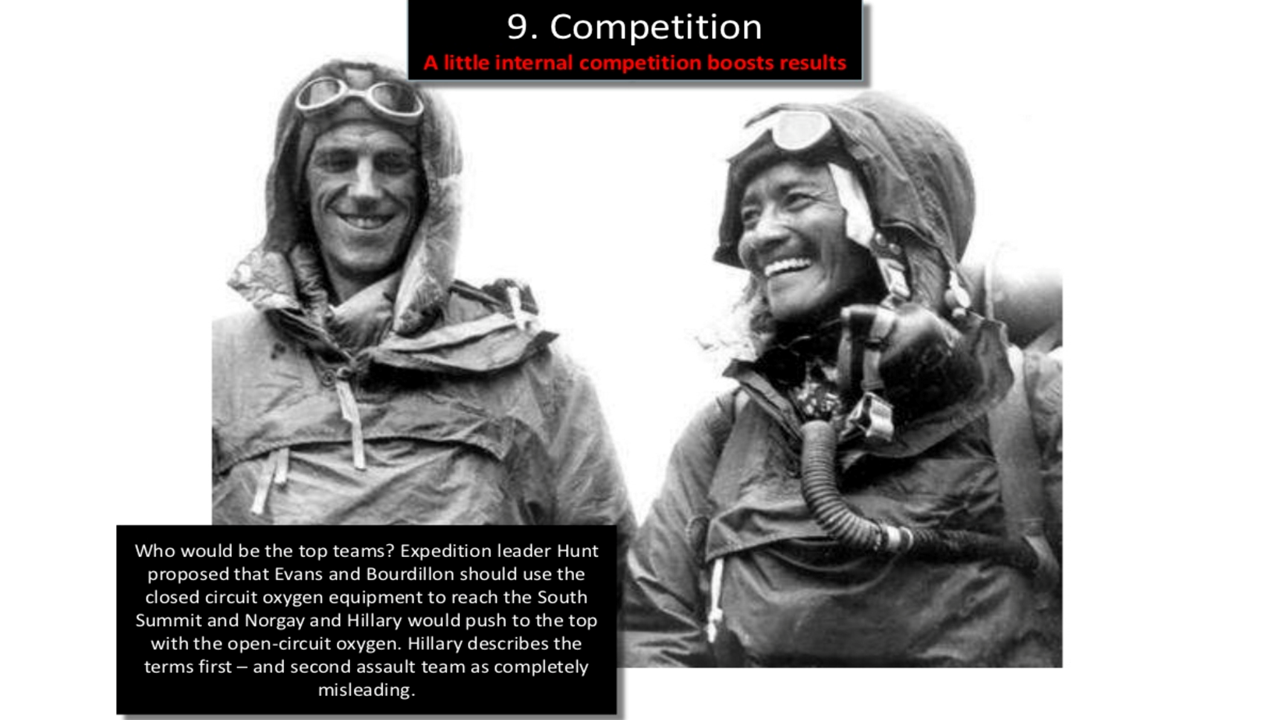
John Hunt proposed that Evans and Bourdillon would use the closed-circuit oxygen to reach the South Summit and Hilary and Norgay would push to the top with the open circuit oxygen. Hilary denies that there was a first and a second assault team pitted against each other but there is no doubt that a little competition can be useful.
9. Competition
Think about it - What happens with any new initiative? People say We don’t have time for change! But everyone has time for the Xmas Decoration competition. As a leader, you can use Gamification to promote competition. Did you know that the US military use games in their recruitment process - you play an online game and those who are really good get recruited! And Volkswagen with its Fun Theory programme used competition to promote innovation.
10. Courage
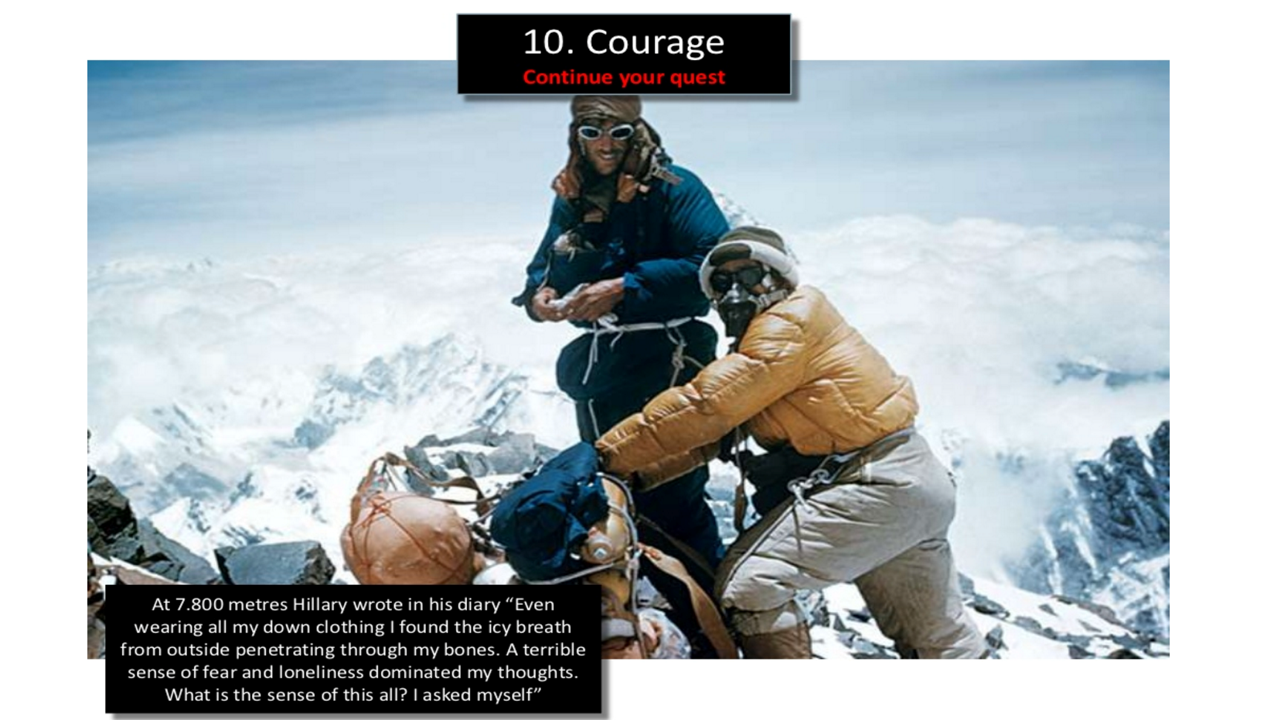
To reach the summit took enormous courage. At 7,800 metres Hilary wrote in his diary “Even wearing all my down clothing, I found the icy breath from outside penetrating through my bones. A terrible sense of fear and loneliness dominated my thoughts. What is the sense of this all? I asked myself.”
We all know the end of the story - a crucial last part of climbing Mount Everest is a 12-metre rock face, which Hillary managed to climb. Today it is known as the Hillary Step.
They reached the 8,848-metre-high summit, the highest point on Earth, at 11:30 a.m. on May 29, 1953. The newspapers reported that Hillary told the team they had succeeded “in rough New Zealand slang.”
Do you know what he said! He said, “We knocked the bastard off!”
I run a webinar on leadership. If you’re interested, get in touch - let’s talk!