The proplem with waiting lists is …
they’re not a queue - they’re a priority pool.
Most patients think that a waiting list is a queue. Patients ring up the Waiting List clerks and ask how far up the queue they are; how many people are in front of them etc. But patients don’t get taken off waiting lists in the same order that they were put onto them. If another person gets worse, their priority goes up and they will be seen or have surgery before those who may have gone onto the list before them. A place on the list is determined by clinical priority not by length of time on the list.
Procedure Waiting Lists vs Activity
One of the issues is that there doesn’t seem to be any correlation between the amount of work to be done and the amount of work that is able to be done.
I haven’t presented the numbers here however if you review data relating to some common procedures, you will see that in some centres, there are large numbers of people on Waiting Lists for a first specialist appointment or a procedure, often more than can be done within a year.
Where the waiting list involves numbers of patients waiting more than a year, these patients can’t be said to be “waiting for an appointment” or “waiting for surgery.” Given the numbers involved, it would be more accurate to say that they have no prospect of being seen within the foreseeable future, especially if they are categorised as “non urgent” or “routine”.
Processes and Flows
Many years ago I was involved in a project working with the then Central Regional Health Authority to move from waiting lists to priority scoring systems. The Ministry of Health at the time proposed a system whereby people who were urgent enough to require surgery within 6 months would be booked for surgery. All others would be returned to the care of their GP.
Why six months? Six months was selected as a reasonable planning period. Beyond six months, the patient’s condition may have changed, and they may need to be reassessed. It was also regarded as the maximum length of time that a patient should wait if they are assessed as needing surgery.
All these years on and although we appear to have some scoring or prioritising systems, we still seem to have the old Waiting Lists with all the concomitant problems (sigh).
I don’t think that there is recognition of the linkage between capacity and performance. If a centre only has the capacity or funding to do 50 of Procedure X each year, then there is no point placing 100 people on the Waiting List for that procedure because they simply will not get done. People should proceed to be booked for surgery at a rate which is consistent with the ability to perform the surgery. To do anything else is being less than honest.
People need to know what prospects they have of getting their surgery. The issue shouldn’t be fudged. If the surgery can’t be done within six months, that should be made clear so that a person can plan their life appropriately and, if able, consider other options. Too often, a person is told that they have been put onto the Waiting List with no real indication of when they will get to be seen or have their surgery - not because of any lack of care or thought but simply because the numbers make it impossible to predict! What happens is that people put their lives on hold - they cancel trips, they sit at home waiting for the call. And the cruel reality is often that the call may not come for years, if at all. This is simply not fair.
A similar linkage needs to be made with contacted volumes. If the contract is to perform 100 of Procedure Y, then there is no point in accepting the commitment to do 150. Again the issue is about clarity and openness. These are hard issues to deal with when a doctor is face to face with the patient, but in my view it is better to be clear about their prospects and present them with an accurate picture than to fudge it and hope that things work out.
Prioritising systems
Back when I was involved in the project, the pressure over waiting list numbers reinforced the view that there was a need for some standardised categorisation system that was capable of finer gradation that the then commonly used “urgent,” semi urgent” and “routine.”
Scoring was seen to be:
explicit rather than implicit,
better than what was happening.
Common scoring systems try to quantify things like degree of pain and functional disability. This process had previously gone on inside the doctor’s head. He/she made a clinical assessment of the patient, ranking the urgency of their condition in an implicit way. The scoring or prioritising system makes that process explicit. It spells out the various clinical and social criteria that are considered in categorising the patient.
Standardised systems also make it possible to move towards equity of access to services throughout the country. If we accept the desirability of this principle then we also have to accept that a standardised method of assessing and categorising clinical urgency, such as a scoring system, is needed.
The backlog
But what about the backlog currently on the Waiting List? With waiting times in some places over 12 months even to be seen for a first specialist appointment, prioritising seems to have gone off the rails.
In an ideal world, in order for prioritization systems to work, we need to be in a “steady state” situation. The model of the “Bath” below illustrates how this works. Inflow equals outflow and thus the level of the “bath” remains constant. In order to reduce the level of the bath, some sort of one-off initiative is needed.
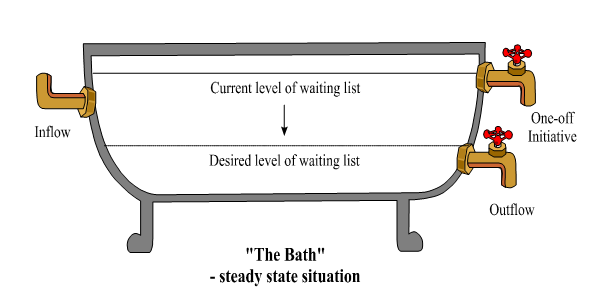
However, those working at the coalface know that temporarily increasing surgical throughput via a waiting list initiative will probably see a corresponding increase in referrals to outpatient clinics and maybe even an increase in numbers of people going to their GP with problems. We seem to be stuck with a situation where demand is destined to always outstrip supply.
Conclusion
The issues and the problems of access to surgical services are complex. And as someone who is currently waiting for a first specialist appointment (with a view to surgery), being told that the waiting list to be seen is in excess of 12 months has brought this problem into sharp focus for me.
I wrote the original version of this paper back in the early 1990s. It’s quite dispiriting to realise that nothing has changed. In fact it appears to have gotten much worse.
Do you work in the health sector? I’d be really interested in your thoughts!